Algebra Kart
footage coming soon
Algebra Kart
Kart racing meets algebra. Every power-up is an equation. Speed is mastery.
Kart racing meets algebra. Every power-up is an equation. Speed is mastery.
Build networks, master graph theory, out-think the AI.
Early Algebra Kart prototype — real-time networked racing, genetically-evolved AI drivers, and live in-race music synthesis, running on a solo-built C++ engine.
Playtesting vehicle physics as an active player — racing alongside AI bots whose fitness scores evolve live, shaping how their driving challenges you. A dedicated AI showcase clip is coming next.
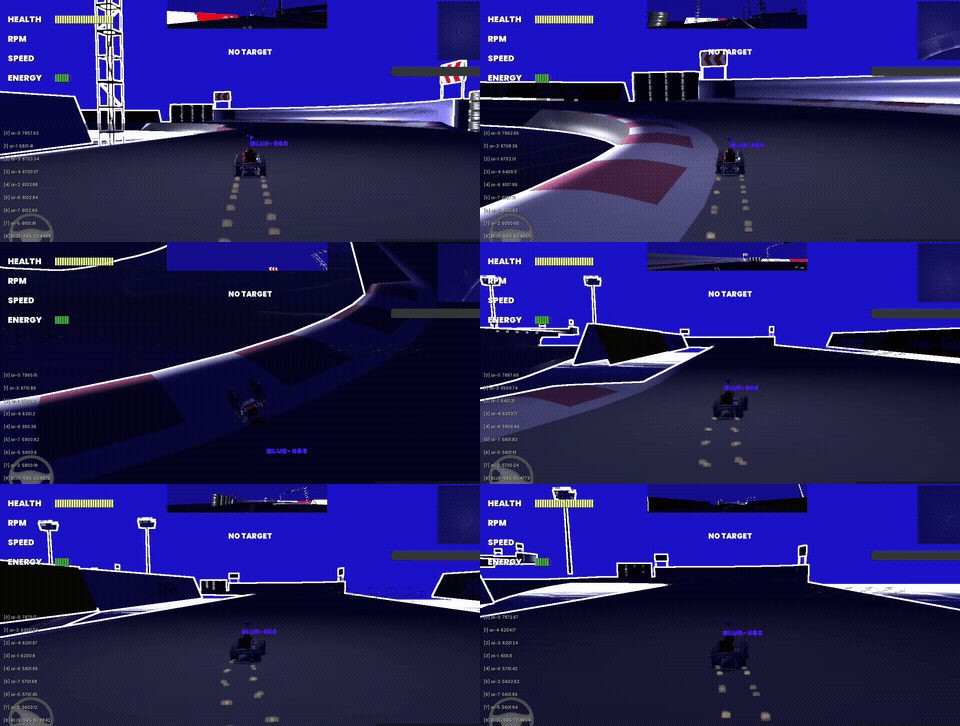
Same clip, GIF loop — for anywhere a video tag doesn't play nicely.
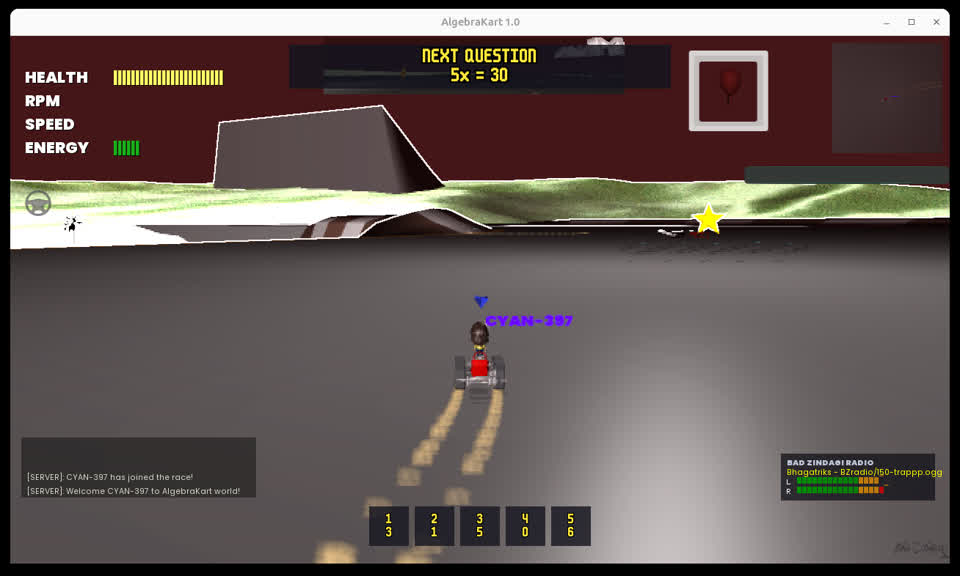
Group questions compete while challenging the mind.
A real-time strategy game about building and connecting rail networks — teaching graph theory through the very thing you're building: routes, nodes, and the shortest path between chaos and victory.
We build in the open. These are the real design docs behind the games — the same ones the code gets written from, published as they're written, for anyone following along with the dev log.
What the AI actually does today, traced from source rather than from intent — the component map, the evolution loop, the fitness signal, and an honest accounting of the defects that currently stop the network from influencing how the bots drive.
Where the AI is going: an LSTM core so behavior depends on history, 15-minute wall-clock evolution epochs with checkpoint and resume, a 40-channel sensory redesign, and three separate fitness channels for driving, algebra, and beat-making.
Four voices share one room and one clock. The full design for Turiya's group music space: session roles, sound design, tempo sync across the network, and the Mandelbrot waveform visualization that grows out of the ground as you play.
More coming. Each doc is published as it's written, with its real build status on the front — what's implemented, what's still design-only. Nothing here is a pitch deck; if a section says it isn't built yet, it isn't built yet.
Turiya is the software engine underneath every Monkey Maya game: real-time sound synthesis, shared live over a network in one space. Multiple players plug into beat machines and a range of digital instruments — tracked across a 16×16×8 pattern grid — with everyone's timing captured against a shared clock, so the whole group behaves like several DAWs recording in perfect sync, all inside the same shared sound space.
Solid lines are live today. Dashed lines and boxes are planned, not yet supported.
Maya Space — a collaborative learning system. A room of players and voices sharing one clock, where every sound grows a living structure out of the ground together.
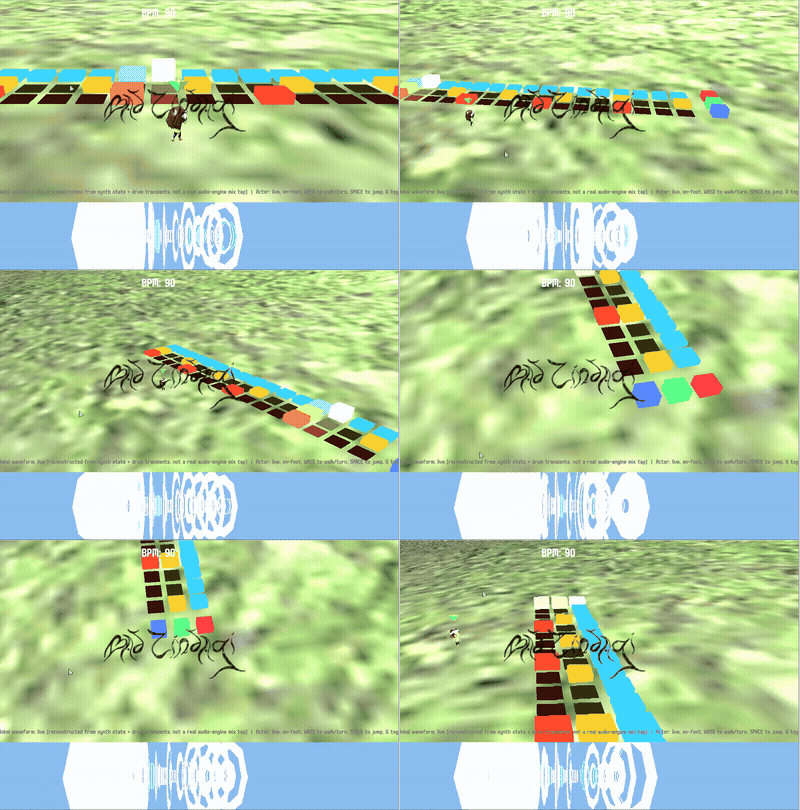
Turiya running live — walking a beat track as the kick and snare pattern lights up the tiles beneath you, with the shared waveform playing out underneath in real time.
Every Monkey Maya game ships with Turiya running underneath. While you race, build, or explore, everyone in your session is collaboratively generating music in real time — driven by the moves you're already making. Every session is tracked server-side, and you can save what you made in a high-quality audio format to keep, share, or remix later.
Networked drum machines and instruments respond to gameplay, shared live across every player in a session.
Every sequence is logged server-side as it's created, so nothing your group makes together is lost mid-session.
Save what you made and take it with you in a high-quality audio format once the session ends.
 AB
AB
Ajay Bhaga
Solo Developer → Lead Designer & AI Development Manager
Ajay served as Managing Partner at Munvo Solutions, helping Fortune 500 companies design & build real-time marketing automation systems globally. Ajay has held positions at engineering companies such as IBM, Rapid7, and WatchGuard Technologies. His on-site consulting projects spanned industries including banking, financial services, high-tech, telecom, health insurance, gaming, hospitality, loyalty, airlines, publications, retail, and digital payment systems.
He's now a Staff Software Engineer in Cloud Platform Engineering at WatchGuard Technologies.
Ajay studied at the University of Toronto, where he earned a B.Sc. in Computer Science, Software Engineering.
A look at how the engine underneath Monkey Maya's games is actually put together — drawn directly from the codebase, not marketing diagrams.
Every game runs on a custom layer built on top of Urho3D's scene graph, physics, and networking, with four gameplay systems sitting side by side and feeding a shared multiplayer replication layer.
Movement feels instant for the player driving, while the server stays the single source of truth — a standard client-side-prediction pattern, tuned for kart racing.
Each bot's driving behavior is a small feed-forward neural network. A genetic algorithm evolves the population generation over generation, using in-race performance as the fitness signal.
The genetic algorithm above evolves each bot's network across generations. This is the other half: how a bot actually decides where to steer on any given frame, blending its network output with a reactive heuristic and a waypoint-following fallback.
Design credit: this engineering builds on established open and public reference work rather than reinventing every piece. Turiya, the music synthesis engine, is original; procedural vegetation started from an open-source Urho3D community reference. Full credits below — a third-party licensing review is in progress ahead of commercial release.
Algebra Kart and Railroad Quest are the first two games released on Turiya, our real-time, multiplayer creation and collaboration platform — with its live music synthesis engine as the foundation underneath every one of them. Think of Turiya as a co-creation time-space — the same live, social, physics-driven world every Monkey Maya game already runs on, eventually opened up as its own standalone tool for collaborative creation.
Monkey Maya's engineering stands on real prior work. Full credit to everyone below.